.png)
What have we been up to?

NAACP sponsors Louisville Orchestra performance at Franklin Square

The Jeffersonville/Clark County Branch of the NAACP sponsored a special event for the graduating fifth graders at Franklin Square Elementary School in Jeffersonville on Monday.
The Harmony Duo Ensemble from the Louisville Orchestra was made up of Violinist Kayla Bryan and Cellist Han Lee. They entertained and educated the students with an hour-long concert.
Our Branch chose Franklin Square because NAACP supports public schools and many of our members are graduates of Spring Hill and Maple Street Elementary schools. The students at Franklin Square did not get the experience of a brand-new school built from ground up like students at the other Greater Clark County elementary schools. They are located across the street from the Clark County Jail and the location screams marginalization, “from the schoolhouse to the jailhouse.”
Therefore, we wanted to do a fun but educational activity for the more than 65 graduating students. What could be more fun than listening to music, which causes all of us to tap our feet with joy?.
The music genre began with a tango. The students learned the Louisville Orchestra plays a variety of music from classical to pop and rap. They quickly identified the theme song from the movies, “Harry Potter” & “Jaws.” The duo used their instruments to demonstrate fast and slow tempos, rhythm and how to feel the music.
Students asked questions about the use of technology and the duo showed them how they use an iPad and their foot to turn pages instead of them actually turning pages of paper sheet music. Also, they demonstrated how the use of a small rubber “mute” makes their instruments have a softer sound.
Principal Jackie Diaz said, “it was great my students had the ability to engage with musicians. It afforded them an amazing and deeper appreciation of orchestra music.”
Mary Milliner, Franklin Square’s lead fifth grade teacher said, “the students were excited to have the Louisville Orchestra members with them today. The students were engaged and thoroughly enjoyed the performance.”
NAACP President, Sue Wright, and Finance Chair, Renee Baines enjoyed the music while watching the expressions on the students faces. It was wonderful hearing the questions asked by the students, but also their answers to questions asked by the musicians.
Community members discuss low voter turnout at NAACP event
ANDREW HARP andrew.harp@newsandtribune.com Apr 1, 2026
News and Tribune
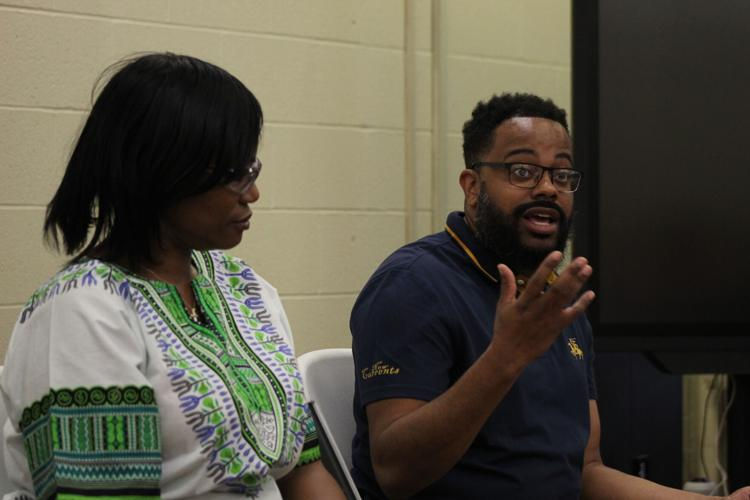
JEFFERSONVILLE — Several people attended a Jeffersonville NAACP event on why or why not people in the community vote in elections.
Titled “When Voting Feels Pointless: A Real Community Conversation,” it was hosted by Clark County Council member and Jeffersonville NAACP vice president Teah Williams-Hampton, along with panelists Melvin Boyd, Vincent Thomas and Stephanie Green, on Tuesday at Community Action of Southern Indiana.
To begin, Williams-Hampton pointed out the fact that the area has had low voter turnout, especially in the primary and non-presidential elections.
She said community organizers and civically engaged people need to understand why people might not vote, or why they have stopped voting in the first place. She said for them, there ought to be no such thing as “off election years,” since these elections determine important local leaders that directly affect the area.
“There’s a reason why it gets told to us that our votes don’t matter,” Thomas said.
For Green, she said that civic engagement is something that starts in the home, early on with children. However, she also said from talking to local residents, they feel that the system itself is rigged. She said that those who can must fight for a better future.
“I can’t complain if I don’t take action,” she said.
Boyd also said, especially among Black people, that they don’t believe in defending a system that did not protect them to begin with.
Thomas said that he feels people will not vote if they feel the issues do not personally affect them.
Williams-Hampton subsequently asked the question of what people hear from others as to why they don’t vote.
There were several responses, including a lack of trust as a result of politicians who are elected but then don’t follow through on promises they made while campaigning.
One of the points that was made was trying to look at voting not always as a way of winning but as a way of putting across one’s values.
Green said that when President Barack Obama won the election in 2008, she cried because she was involved in that process and so it became meaningful.
“Whether they win or not, I know I played a part, and I know my voice was heard,” she said.
Jeffersonville City Council member Evan Stoner said that everyone must be involved in the political process, including young people.
Poverty and capitalism was also discussed, about how it puts people into this cycle where they may not have the time and energy to research candidates and issues to vote in their best interests.
Green also said, however, that the research must be conducted by someone and somehow in order to hold people accountable and prevent the passing of legislation or policies that hurt their community.
Williams-Hampton then asked what people should do once voting is said and done.
Green further said that for her, she will always try and fight for other people’s rights, and be willing to fight for one’s rights.
“I’m gonna do what I’m gonna do for all the children,” she said.
Thomas said he also believes that it should be less taboo to talk about political and societal issues more openly and casually.
Ultimately, Williams-Hampton said there’s a sense of powerlessness among every day people, not that they don’t care.
ICE, crime stats discussed during Jeffersonville Police/NAACP community meeting
ANDREW HARP andrew.harp@newsandtribune.com Jan 14, 2026
News and Tribune

Andrew Harp | News and Tribune
JEFFERSONVILLE — The Jeffersonville/Clark County Branch of the NAACP and the Jeffersonville Police Department convened along with other community members to ask questions, even difficult ones.
The first quarterly community meeting was held at the JPD police station on Tuesday.
In September, the NAACP chapter held their monthly meeting with leaders of JPD at the station, including the then interim Chief Scott McVoy, who is now the chief.
“One of the things that we discussed last time was how is the Jeffersonville Police Department going to keep our minority community safe?” said NAACP President Sue Wright.
From there, the two entities agreed to have these quarterly meetings where anyone could come and ask JPD leadership questions. They are essentially community forums.
Wright said they wanted to continue this trend of open communication with the department.
“This is wonderful because this allows people to see who their police officers are, and then a chance to talk to them,” she said.
“We want to hear what people have to say, whether that’s within the community, whether that’s within the department,” said JPD Assistant Chief Josh Lynch.
Lynch said that in order to know about issues that may be happening in the community, community members must let the department know about them.
“It is important that we have these conversations and talk about issues so that we can develop a plan,” he said.
Clark County Democratic Party Chairman Miguel Hampton did ask Lynch about the U.S. Immigration and Customs Enforcement and their legal protections.
He asked that if ICE ramps up their activity in the area, and if there was a situation similar to the killing of Renee Good by ICE agents in Minneapolis, Minnesota, would JPD be able to suitably protect residents and protesters.
“It’s important for our community to know who is actually there to protect us in that situation,” Hampton said.
Lynch referenced protests that occurred in the city a few years ago, and said that they were then focused on protecting protesters, and that nothing has changed.
“Whatever you’re protesting, you have the right to protest,” he said.
However, Lynch also said that there is a difference between a protest and a riot.
“There is law, and then there’s lawlessness,” he said.
Lynch said that the department had a discussion about their policies regarding ICE, and that it’s “something that we are looking into.” He said JPD has not had any contact with ICE at this point.
“We are not going to allow for ... violence in any arena,” he said.
Hampton posited the possibility of local children being followed by ICE agents. He also asked Lynch if the police could be relied on in these instances as well.
“If you think that there’s someone that is harassing your child, then we’re going to look into that, whether it’s an alleged ICE agent or an alleged stalker,” he said.
Lynch said that they have also typically had good communication with federal agencies.
“We have a great relationship with our federal partners meaning that we communicate very well. So if there is an investigation of any sort ... we are aware of it in most cases,” he said.
He said he can’t imagine a situation in which there was no professional courtesy given to them if operations were to occur in the city.
He also said that there have been situations in which federal agencies have presented a plan to the department, and the department pushed back about how it was planned to be conducted.
Lynch also discussed a bit about statistics regarding crimes in the city in the past year or so.
He said that “property crimes are way down,” and attributes this to getting people connected to services that are in need. These crimes include burglaries, which used to be at an average of around 500 per year in the early 2010s, and in 2025 they had 52 burglary reports.
However, Lynch also said that displacement can cause crimes to be lessened but then dispersed into other areas. He said that staffing then becomes an issue, since resources then need to be pulled and rearranged.
Lynch added that they took 60,000 calls for service last year.
“We put more people on the street ... than we’ve had in probably the history of the department,” Lynch said.
McVoy said he plans on presenting to the Jeffersonville City Council in February their numbers and statistics from the past year.
“You have to use the numbers and the data to analyze where your problems are in communities and be able to deploy manpower to those areas,” McVoy said.
The three next meetings will be held April 14 at 1406 Frederick Ave., July 14 at 460 Spring St. and Oct. 13 at 1425 Bates-Bowyer Ave. All these meetings start at 5:30 p.m.
Local, state NAACP leaders denounce threats against lawmakers; express opposition to midcycle redistricting
DANIEL SUDDEATH daniel.suddeath@newsandtribune.com Dec 10, 2025
News and Tribune

SOUTHERN INDIANA – State and local NAACP leaders are calling for an end to attacks and threats against legislators.
In recent weeks, multiple elected Indiana Republicans have reported being the targets of threats including swatting attacks as state lawmakers consider midcycle redistricting. The attacks followed President Donald Trump’s comments about the issue including his social media posts expressing displeasure with Indiana Republicans who stated they wouldn’t support redistricting this year.
Trump and other GOP proponents have called on Indiana to redistrict to help keep a Republican majority in the U.S. House. Indiana typically redistricts every 10 years, with the latest maps approved in 2021 following the 2020 census.
The Indiana House last week advanced the new map, which advocates believe will secure all nine congressional seats in the state for Republicans. The GOP currently holds a 7-2 advantage in U.S. House seats.
The Indiana Senate is expected to vote on the new map as early as Thursday. The 9th District, which includes Clark and Floyd counties, would shift under the proposal and stretch further north to include a portion of Indianapolis.
In a statement issued Tuesday, the Indiana NAACP denounced the “criminal and cowardly” actions against legislators
“Indiana legislators take a solemn oath to faithfully execute the duties of their office as a member of the state’s governing body,” the NAACP stated. “All such conduct is criminal action intended to prevent legislators from carrying out the will of their constituents, and instead to vote in favor of unlawful redistricting.”
While most of the reported incidents occurred against legislators who are opposed to midcycle redistricting, Gov. Mike Braun said last month that his family had been targeted with threats. Braun supports the redistricting initiative.
Sue Wright, president of the Clark County NAACP, said the organization opposes threats and bodily harm against anyone. She placed the blame for the intimidation against Indiana legislators on Trump.
“For over 100 years, women and people of color have fought for social justice, civil rights and voting rights, so we strongly oppose anyone who wants to take these principles away,” she said. “Mike Pence finally stood up for fairness when his life was threatened by a mob urged on by the same narcissistic person who is bullying and threatening you.”
Wright expressed her opposition to the redistricting measure and added that personal greed and a hunger for power shouldn’t spill over into Indiana.
“Don’t allow yourself to do his dirty work. He has shown you over and over again, once you are no longer useful, you will be tossed aside like garbage,” she said. “The previous maps elected Mike Braun and Donald Trump, so you don’t have to ‘trump’ others when you are already the winners.”
Clark County NAACP donates to Justice Access Ministries
News and Tribune

In October, the Jeffersonville/Clark County NAACP held a successful community fundraiser. This Freedom Fund Gathering has allowed the Jeffersonville/Clark County NAACP to be able to donate $2,000 to Justice Access Ministries (JAM). JAM is a free legal service focusing on expungements.
“This legal service helps eligible individuals get a fresh start,” says Sue Wright, local NAACP branch president. “The NAACP is glad to join in this good work.”
Additionally, local philanthropists, David and Donna Reinhardt, donated $1,000 to Justice Access Ministries.
The Jeffersonville/Clark County NAACP meets on the first Thursday of each month at 1406 Frederick Avenue in Jeffersonville at 7 p.m. At its meeting on Dec. 4, the NAACP will celebrate the holidays with light refreshments.
Also, FBI Special Agent Ronnie Hornback will provide information about preventing scams. Everybody is invited to attend.
For more information contact Sue Wright, President, Jeffersonville/Clark County NAACP at cornelia.wright@att.net
New interim Jeffersonville police chief and NAACP talk about building community
ANDREW HARP andrew.harp@newsandtribune.com Sep 5, 2025
News and Tribune

Photos by Andrew Harp | News and Tribune
JEFFERSONVILLE — The Jeffersonville Police Department’s new interim chief talked with the community Thursday night, outlining his perspective on going forward.
The Jeffersonville/Clark County Branch of the NAACP and the police met at the JPD station.
“We should feel very welcome coming into this police department ... and we should never be afraid to talk about what we stand for in this organization,” said NAACP President Sue Wright at the meeting.
Wright said the organization stands for diversity, equity and inclusion.
“We are going to continue to say that every time we get an opportunity so that everyone knows,” she said.
The meeting was set up in August just before former Chief Kenny Kavanaugh was replaced by former Deputy Chief Scott McVoy. McVoy now serves as the interim chief.
“For me, my goal is to take this police department, continue to move it forward,” he said.
As shown in a presentation during the meeting by Assistant Chief Josh Lynch, Kavanaugh now serves as the east division captain in the department.
McVoy, who is of Hispanic descent, said this was his first week as the JPD interim chief. He has been working at JPD for 15 years, and before that was a patrol officer in Madison.
“I love this community. This community has been very, very good to me,” McVoy said.
Despite the fact that the NAACP meeting was scheduled by Kavanaugh, McVoy said he did not want to cancel it.
“Law enforcement isn’t just about enforcing the law. We have to build partnerships, we have to build trust within the community,” he said.
McVoy said he believes in community partnerships and openness to talk about issues and admit when something is wrong.
He said that he studied the story of Emmitt Till while he was attending the 12-week FBI National Academy in Quantico, Virginia.
He said that when he hires new officers, he tells them to write a one or two page report about the Till story after they read about it, to talk about how it made them feel. If it ends up being a report of the story, he tells them to go back and write it again.
“I believe in the value of education and what we’re learning, not just from a law enforcement academy, but from outside scholastic professors and colleges to get a more broader perspective of law enforcement,” he said.
McVoy said that the department is diverse considering national averages. He said they will soon have a total of around 90 officers. They currently have two Hispanic officers, not including himself, 13 female officers and nine African American officers, two of whom are in the command staff.
McVoy said in the past 10 years while he was the deputy chief, he remembers attending one or two meetings with the NAACP.
“That’s unacceptable. It’s unacceptable on our part,” he said.
“If I’m not willing to listen to every segment of my community, then I’m failing,” he said.
Lynch presented the call volumes. There were 46,272 calls for service in 2024. From January through August of 2025, they have had 41,484 calls for service.
McVoy and Lynch also discussed the intelligence technology they have that collects data of crimes in the city, and creates heat maps where they can spot patterns. This helps to eliminate policing by randomization.
“Randomization is what led to lack of trust, lack of transparency, because you weren’t relying on data, you weren’t relying on technology,” McVoy said. However, he also said that technology still needs that human interactive element.
McVoy also said that the department regularly interacts with those facing mental health issues, homelessness and substance abuse issues. He said the police department cannot do it alone, and that he wants to bring even more people and organizations together to find solutions for people in need.
“Right now, it’s like a fishbowl. We’re just moving people around. That’s not fair to the community, it’s not fair to those who are affected with mental health or substance abuse,” McVoy said.
Clark County NAACP elects new leadership for 2025
ANDREW HARP andrew.harp@newsandtribune.com Mar 13, 2025
News and Tribune

JEFFERSONVILLE — New leadership has been elected to serve for at least the next two years for the Jeffersonville Clark County NAACP branch.
Cornelia Wright was sworn in as president of the branch on March 6, along with two vice presidents, the treasurer and the secretary.
Wright is originally from Jeffersonville. She has lived in different places including Indianapolis and San Diego. She’s a retired AT&T employee. She moved back to Jeffersonville in 1998.
She has a master’s degree in business management from the University of Redlands in Redlands, California.
Wright was the first African-American district governor for Rotary Club District 6580. Wright still serves as the chair of the DEI committee for the district.
Wright said that the national NAACP organization talks often about equity, diversity and inclusion.
“The United States has taken that and made that very political, but what they’re truly missing is the human side of all of us,” she said about DEI.
She said one of her foremost goals is to bring back members who may not have attended a monthly meeting in a while. Meetings are 7 p.m. the first Thursday of the month at 1406 Frederick Ave.
“I want our meetings to be vibrant and fun and not just about...the business of the organization itself,” Wright said.
Wright said she wants to invite community speakers to meetings and to also reach out to other community organizations to talk about their projects and how they can work together, including the LGBTQ community and Hispanic community.
“Hopefully the NAACP now can have those intentional conversations with other people in the community...we need to unite and work together, we cannot continue to be divided,” she said.
Clark County Council member and NAACP youth council adviser Teah Williams-Hampton was sworn in as first vice president of the branch. She said she has been a member of the NAACP since middle school.
“That organization is really near and dear to my heart,” she said.
Wright said she wants to work toward getting the membership more involved and having more engagement in the community.
“We’re in some very, I would say, interesting times politically, and I think that I’m not sure that people really understand what the NAACP is all about,” she said.
While the youth council is essentially a separate branch from the adult one that Wright is the president of, she said she will continue to support the council, considering it is one that is growing fast.
“They strive to be very visible in the community and so I would like for the adult branch as is called to also be visible in the community and to market ourselves too, and get out there,” Wright said.
Wright also said that she wants to go beyond the typical NAACP community outreach with its voter registration booths at events.
“I’m not saying that that’s not important because it is very, very important. However, I also think we should be showcasing our history and what we are doing in the community,” she said.
Williams-Hampton said that while the organization is non-partisan, it doesn’t mean that they are not a political organization, focusing on organizing for policies that advocate for equal rights.
“I’m really hoping that we are able to move in that direction with the ... current branch that we have, which has historically been a very active and powerful branch,” she said.
Wright said that everyone wants to feel included, and so work needs to be done to include everyone to deter bullying in schools and discrimination overall.
“The purpose is to unite for good,” she said.


Comments